

By Tim Johnson, CFRE, CFRM
The students honestly believed they had created an elegant plan.
They knew they were getting back to campus late after lunch and would be tardy for geometry class. So they relied on the tried-and-true “flat tire story,” but with embellishments. They had a flat tire, didn’t have a jack, and a guy named Kyle stopped to help. While changing the tire, Kyle hit on one of the girls. They rehearsed their lines, right down to interrupting the leader to throw in details.
Simple. Elegant. Foolproof.
Until they arrived at class. The teacher separated them and asked them to write the answer to one simple question:
“Which tire was it?”
Nobody’s answer matched.
That one decision didn’t mark anyone’s life forever. It was a dumb, rehearsed lie on a Tuesday, and then it was over. Those students got to grow up and become people that moment never had to define.
Not all lies reflect true character.
Ask who Barnabas was, and Scripture hands you a whole life: a man who vouched for Saul, helped lead the church in Antioch, and took a chance on John Mark after Paul had given up on him.
Ask who Ananias and Sapphira were, and Scripture hands you five verses and two deaths. No hometown. No history before this moment. No mention after it. Whatever this was for them, it’s the only portrait Scripture gives us of who they were.
 Not a Financial Sin
Acts tells Barnabas’s story in two verses. The very next verses tell another one, on purpose, right beside it.
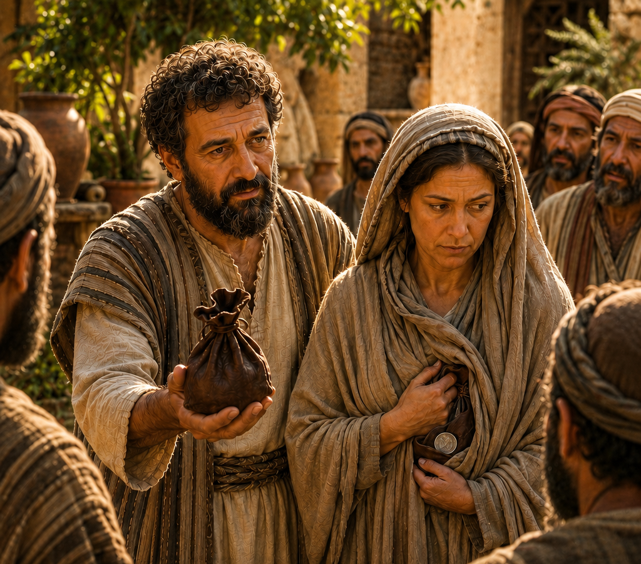
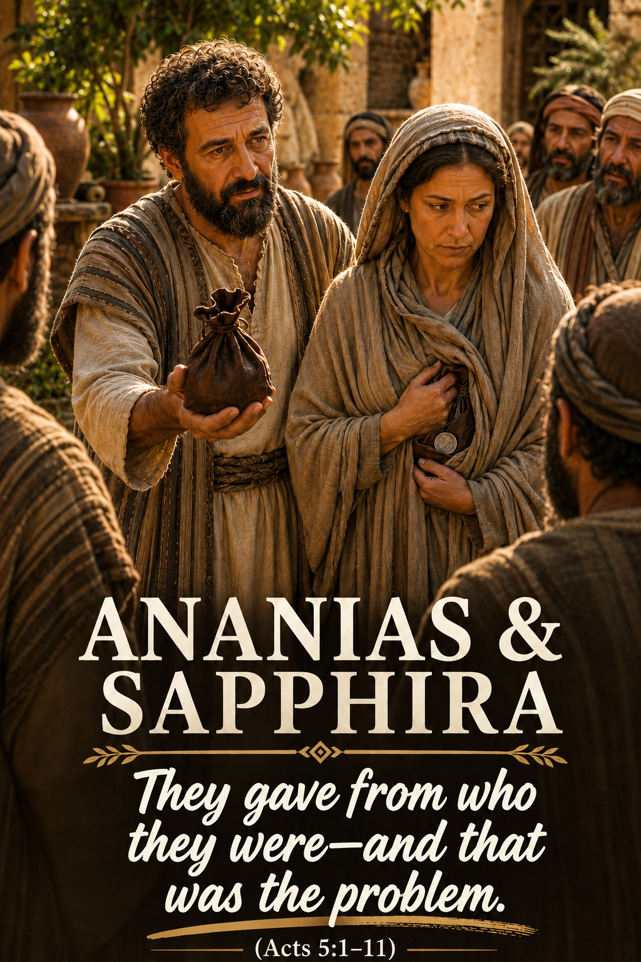
Ananias and Sapphira also sold property, but they kept part of the money and claimed they had given it all. Peter makes clear they were free to keep the entire amount; the sin wasn’t the size of their gift but their attempt to gain the praise Barnabas and others received without the transformed hearts that made their generosity genuine.
That kind of respect isn’t for sale.
So they schemed, acted, and lied to get a bit of glory.
Which Tire Was It?
Here’s the detail I keep coming back to.
Peter questioned them separately. Sapphira arrived with no idea what had happened to her husband and gave the same account. Acts tells us the plan was made “with his wife’s full knowledge.”
That’s not a lie one person told under pressure. That’s a story two people built together, confident enough in each other to tell it separately and have it hold.
And it held up fine until someone asked a plain question nobody had prepared for:
“Did you sell the land for this amount?”
Not a trap. Just the kind of question a true story never has to brace for.
Which tire was it?
They Weren’t Wearing a Mask
Those students lied because that’s who they were in that moment. They hadn’t matured to the point of accepting responsibility yet. Most teenagers haven’t.
Ananias and Sapphira were different.
They didn’t fail to act like themselves. They succeeded at it.
Their lie was self-centered, image-building, and more concerned with how the moment looked than with what it cost.
In contrast, Barnabas’ gift didn’t create a generous identity. It revealed one that already existed.
Paul describes the difference: Don’t conform to worldly ways of living; be transformed (Romans 12:2). Conformity lets pride, greed, and the values around us shape who we become. Transformation produces something different.
Sometimes it even produces a name like Barnabas.
Surrounded, and Still Themselves
There’s one more detail, and it isn’t really about Ananias and Sapphira.
Acts 4 describes the community around them as “one heart and soul.” People held what they owned loosely. “Great grace was upon them all.” Barnabas wasn’t the only generous person there; his gift was an example of what was happening throughout the community.
Ananias and Sapphira lived inside that same community, and somehow it never got past their skin.
Proximity to Greatness Doesn’t Make You Great
They weren’t wearing a mask that suddenly slipped. They were being exactly who they had become, in front of the One who was never going to be fooled by the shape of a thing instead of its substance.
So don’t ask whether your story would survive a hard question.
Ask whose story you’re actually living.
Because eventually, what’s inside has a way of answering for you.
Grace is what lets a bad Tuesday stay a bad Tuesday instead of becoming a whole biography. I don’t know why Ananias and Sapphira didn’t get that same room to grow.
I just know I’m grateful when anyone does.
P.S. Don’t ask how I know one student said “driver’s side front tire.”
Discussion Questions
On your social media, take one of the questions and write a response. Or, you can leave a comment on our posts on social media (Facebook, Instagram, or LinkedIn). You can also privately journal your answers.
- Peter’s question wasn’t an accusation. It was plain. Where in your own life would a plain, honest question make you tense instead of free?
- Where are you more concerned with how a gift will be received than with what it actually costs you?
- When you make a donation, do you first think about the good it will do, or the hole it will leave in your bank account?