

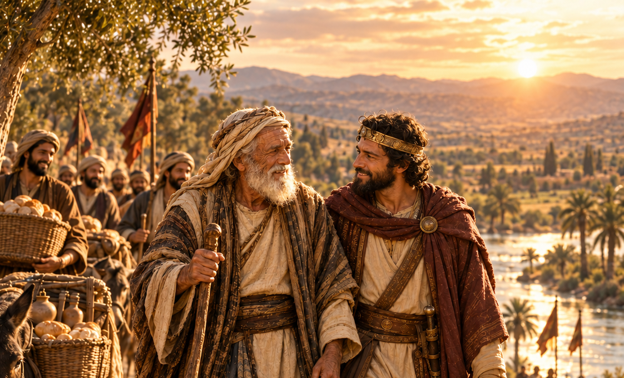
Barzillai Gave Because He Saw a Need, and Was Blessed with Friendship!
By Tim Johnson, CFRE, CFRM
I was walking with a friend not long ago, someone I’ve known for years, sharp, successful, the kind of guy who built something real and then had the discipline to actually stop and enjoy what he’d built. He retired early and started doing what he loved. Somewhere around the second mile, he got quiet, and then he asked me something I wasn’t ready for.
“I know I’m supposed to do something good with what I have. I just don’t know what that is.”
I started to answer the way I usually do: ask yourself what you care about and how much good you could do in the world. Then he stopped me.
“That’s not really it either,” he said. “Even when I think about giving something away, there’s this voice that tells me if it makes me feel good, I must be doing it for the wrong reason.” We walked a long way after that without either of us saying much.
A few days later, I was reading 2 Samuel and came across a story I’m sure I’d read many times but had never really seen. It’s the story of Barzillai, a seemingly minor character who deserves a lot more attention than he gets.
Who Was Barzillai?
We first meet Barzillai near the end of 2 Samuel 17. Later we learn that he’s eighty years old, a wealthy man from Rogelim, east of the Jordan. He had already lived a long life and accumulated substantial resources. He apparently didn’t need much for himself.
Then David shows up, not David the king in glory, but David the king fleeing a rebellion. His own son Absalom has driven him out of Jerusalem, and he arrives at Mahanaim with his men exhausted, hungry, and thirsty, uncertain whether he’ll ever sit on a throne again. Barzillai knows exactly who this man is. That’s precisely what makes it risky. At that point, nobody knew how the rebellion would end, and aiding and abetting the losing king isn’t very well received.
But Barzillai doesn’t hesitate. Scripture says he and two others brought beds, basins, wheat, barley, honey, cheese (everything a starving camp could need), “for they said, the people are hungry and weary and thirsty in the wilderness.” That’s the whole stated reason. Not a strategic bet on the war’s outcome. Someone was hungry, and he had food.
Barzillai saw a need and took action. No mission statement, no five-year plan, no analytics, and no consideration of expecting anything in return. Just an old man doing the good in front of him with what he already had.
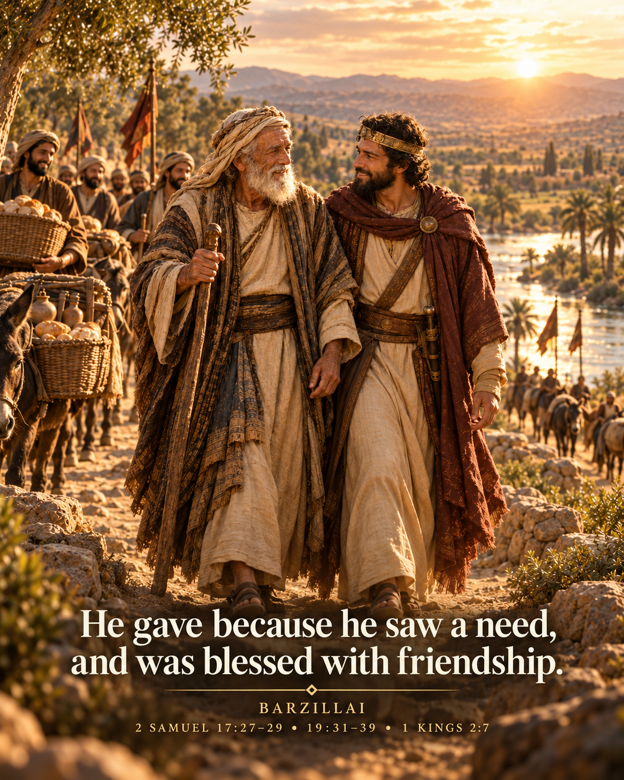
But he didn’t stop at just giving supplies. When David’s fortunes turn, and he starts back toward Jerusalem, Barzillai doesn’t stay home. Scripture says he crossed the Jordan with the king, walking him partway back toward the life he was returning to. He wasn’t one of David’s servants or warriors. He showed up twice, once when David needed provisions, and once when David needed company on the road home.
David treats him accordingly. He doesn’t send a steward to settle accounts the way you’d close out a transaction. He wants Barzillai near, not because his usefulness isn’t finished, but because the relationship was never only about usefulness in the first place. Barzillai never seemed worried about what it would look like to actually enjoy that.
How Barzillai Reminded Me of The Walk With My Friend
That’s the part that stopped me and reminded me of that walk with my friend. When they reach the river, David tries to repay him properly. He invites Barzillai to go to Jerusalem, offers to take care of him for the rest of his life. And Barzillai says no. He tells David that he is old, can’t taste his food anymore, and can’t hear the singers, or really enjoy much of life. He’d rather go home and be buried near his own people.
He doesn’t refuse the blessing outright. He asks David to give it to a younger man in his household (Chimham, likely his son). Let the reward land on the next generation, not on him.
That’s not Barzillai declining a gift. That’s Barzillai redirecting one. He’d already given everything he needed to give. What was left wasn’t his to keep, so he let it keep moving.
Years later, on his own deathbed, David tells Solomon to keep showing kindness to Barzillai’s family, “for they came to me when I fled.” Barzillai was actually the only one that David spoke kindly of at the time of his death. The blessing didn’t stop with Chimham. It kept going.
My View Changed on Estate Gifts
After rediscovering Barzillai’s story, I will never view an estate gift the same way. Over the years, I’ve seen missionaries (people who spent their working lives overseas, who never drew a large salary, who owned a modest house and maybe a paid-off car and not much else) do, quietly and after the fact, exactly what Barzillai did on the banks of the Jordan. They didn’t leave a fortune. They left a redirection. What they couldn’t finish, they handed over to someone else. Maybe a future missionary they’d never meet, a village they never visited, or a people group that needed to hear about Jesus. They trusted the work to keep moving after their part was done.
Of course, this isn’t exclusive to religious or faith-based people. Many of us know the story of Chuck Feeney. The billionaire who built Duty Free Shoppers. He spent his final decades quietly giving away almost his entire fortune before he died, on purpose. He gave away his accumulated wealth rather than working income, refusing the buildings and plaques that usually come with gifts that size. He called it “giving while living.” Different century, different faith, but the same idea. A man who’d stopped accumulating decided what he had left wasn’t his to hold onto, and so he let it move.
Our story continues, adding one more line. David kissed Barzillai, and blessed him, and Barzillai returned to his own place.
That’s easy to read past. It shouldn’t be.
What Did the Kiss Mean in That Culture?
In his culture, a kiss wasn’t a formality. It required real trust, real proximity, and the willingness to let someone get close to you. It’s how family members greeted each other after long absences, how people said goodbye when they didn’t know if they’d meet again. But this kiss was different. It came from a king. And this kiss came at a very specific moment. It came after Barzillai had already turned down everything David offered. David owed him nothing anymore. Barzillai didn’t need anything anymore. All that remained were two friends standing by a river.
I don’t think the kiss was David’s consolation prize for losing Barzillai’s company. I think it’s the moment we finally see what was true all along. None of this, from the food at Mahanaim to the walk to the river, was ever a transaction. It only becomes fully visible once there’s nothing left to trade.
You’re Waiting to Know What “Good Work” Is Before You’ll Act
Here’s what I wish I’d said to my friend on that walk:
You’re waiting to know what ‘good work’ is before you’ll act. Barzillai never knew, not in the way you mean it. He just saw hungry people and had food. Maybe we make things too complicated. Barzillai saw tired, hungry people, and he had what they needed. You already have something that can meet it. Let it go, and don’t be suspicious of the joy or the relationships that come back to you.
And that voice telling you it’s tainted if it feels good? Watch what happens at the river. David doesn’t repay Barzillai with money, because Barzillai won’t let him. Instead, he gets a king’s affection, freely given, at the one moment nothing could be mistaken for payment. Scripture doesn’t flinch from that, doesn’t add a footnote warning us the moment was compromised because it was warm, or because Barzillai probably went home that day feeling something like joy.
You don’t have to choose between doing good and feeling good about it. Barzillai walked home with both.
Reflection Questions
On your social media or in a private journal, write answers to these questions. Or share a comment on Facebook, Linkedin, or Instagram.
- Have you ever had a Barzillai in your life?
- Have you ever been a Barzillai? Why or why not?
- What would motivate you to act like Barzillai?
- What am I holding now that could keep doing good after my part in the story is finished?