

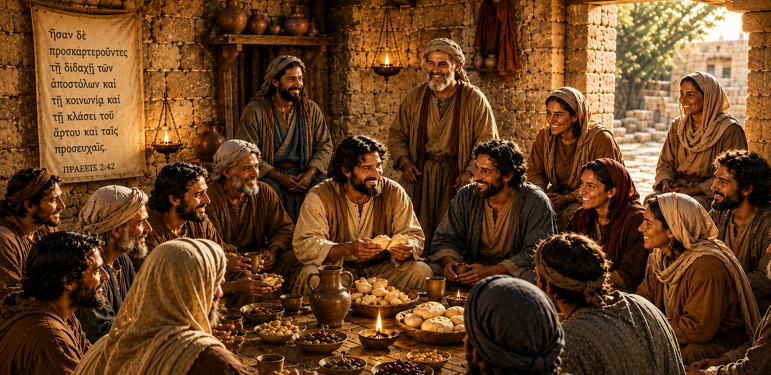
The Early Jerusalem Church, Acts 2:42-47
Third in the Portraits series, following Barnabas and Ananias & Sapphira
By Tim Johnson, CFRE, CFRM
For years, I taught speech and communication, mostly in Kyiv, Ukraine. Every semester, I taught the difference between a major point and a minor point. Some of my best students got so captivated by a minor point they missed the major one entirely.
We’ve done that with Acts, twice over. Ananias and Sapphira, struck down for lying about their giving, gets remembered. So does Barnabas, who sold his field and laid the proceeds at the apostles’ feet. Both true. Neither meant to stand alone.
The First Major Point Is Not the Only Major Point
Luke says it twice, in case once wasn’t enough. All the believers were together and had everything in common (Acts 2:44). Later, restated flatly:
“There was not a needy person among them.” (Acts 4:34)
That was radical, in that culture, in that economy. But even this isn’t the actual major point. It’s a symptom, something that shows up on its own when something deeper is true. Nobody organizes a symptom into existence.
The underlying condition was the Holy Spirit, newly poured out in the same chapter, doing what Jesus said mattered most: love God, love others. “Not a needy person among them” wasn’t the goal, it was what that love looked like from the outside. Acts 2 isn’t telling us to eliminate need. It’s telling us to love as completely as that room did, and let eliminating need be the symptom we can’t avoid having.
Giving and Sharing Aren’t the Same Symptom
Giving is a discrete act with a beginning and an end. Barnabas sells a field, brings the proceeds, and it’s done. Real generosity, but a single event.
Sharing is corporate and ongoing. The Greek word behind Acts 2:44, koinonia, is the same word Luke uses for “fellowship” two verses earlier. In the earliest church, communion and economics were never separate. Sharing was fellowship.
Russell James, a philanthropy researcher, draws a related distinction: giving “down,” almsgiving (eleēmosynē), done quietly, versus giving “across,” among believers, done openly, the way Paul describes in 2 Corinthians 8-9. That second kind is koinonia.
Seen this way, Ananias and Sapphira’s failure sharpens. The property was theirs to keep, Peter says so. Their sin wasn’t withholding it. It was performing open sharing while secretly holding something back, a counterfeit symptom without the love that would have produced the real thing.
A Box of Chocolates
I watched the real symptom appear once, not in a text, but in a small room, on one of the worst days of our lives.
My wife’s mother passed away while we were on the mission field. Grief is hard enough in your own tongue. In someone else’s, it’s nearly wordless. There was very little we could say, or anyone could have said to us.
One of the new believers from the church we’d just begun to plant came anyway. She didn’t have the words either. What she had was a box of chocolates. She sat down with my wife in the middle of the floor, and the two of them cried together.
That wasn’t a gift. Nothing was given and received, nothing completed. It was koinonia in its plainest form, entered into at the exact moment we had nothing to offer and no way to even ask for what we needed. Not a needy person among them isn’t only about property. It’s a love that walks into a room where words have failed and refuses to leave someone alone in what they’re carrying.
What Happens When It Scatters
Those churches were eventually scattered, not by choice, but by the Russian invasion. People who had built their whole shared life in a handful of Kyiv rooms were forced out, into Europe and beyond. What they carried with them was the same love that had formed the symptom in the first place, and it planted churches wherever they landed. Among Baptist churches alone, the only network with hard numbers to report, an estimated 160 have been planted across Europe by displaced Ukrainians in the four years since the invasion (European Christian Mission International). Among every other tradition and every house church nobody’s counting, the real number is almost certainly higher.
It’s the same shape as Acts 8: persecution scatters the Jerusalem believers, “and those who had been scattered preached the word wherever they went.” Displacement became distribution. A people who genuinely loved God and each other didn’t need the original room to keep sharing.
The Point of the Portraits
Barnabas shows what love God, love others looks like in one man. Ananias and Sapphira show what it looks like faked. The Jerusalem church shows what it looks like taking hold of an entire body. None is the major point. All three are symptoms of one:
A people who genuinely love God and love each other cannot help but become a people who share.
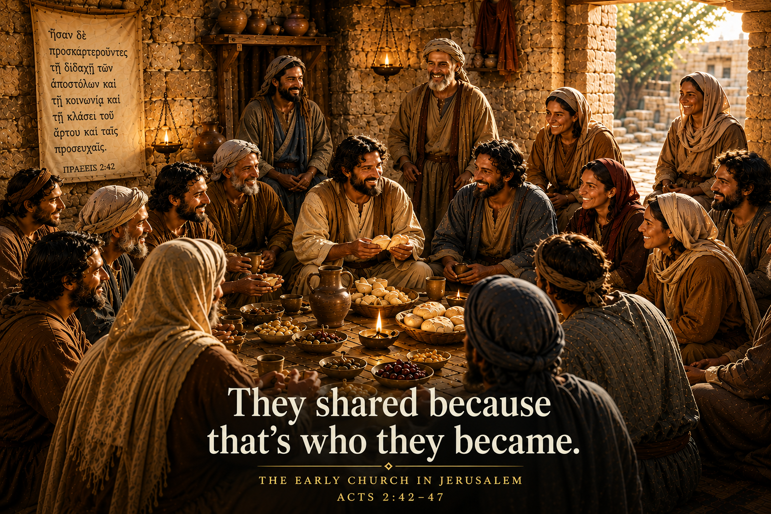
They shared because that’s who they became.
May it be said of us.
P.S. The woman who sat down with the chocolates didn’t just comfort a grieving friend. She shared her heart with my wife and our entire family. Our family still honors our friend and sister every day. She and my granddaughter share the same name: Ryah.
Discussion Questions:
On your own social media, consider thoughtfully answering one of the questions. Or, you can leave a comment on Facebook, LinkedIn, or Instagram.
-
Before reading this, which of the previous stories came to mind first, Barnabas or Ananias and Saphira? What does that say about what tends to stick with us?
-
Where else in your faith might you be focusing on the exciting minor points and missing the major point?
-
What strikes you about the Jerusalem church, not what they did, but who they had become?
-
The church in Jerusalem did not stay together. They scattered and started new churches. If you were one of the scattered, what would you do and how would you do that?
Related Articles:
- Escape From Ukraine
- Viewing the World Through Three Lenses
- Finding Faith by Fighting Dragons
- Acts: Foundations on Missions